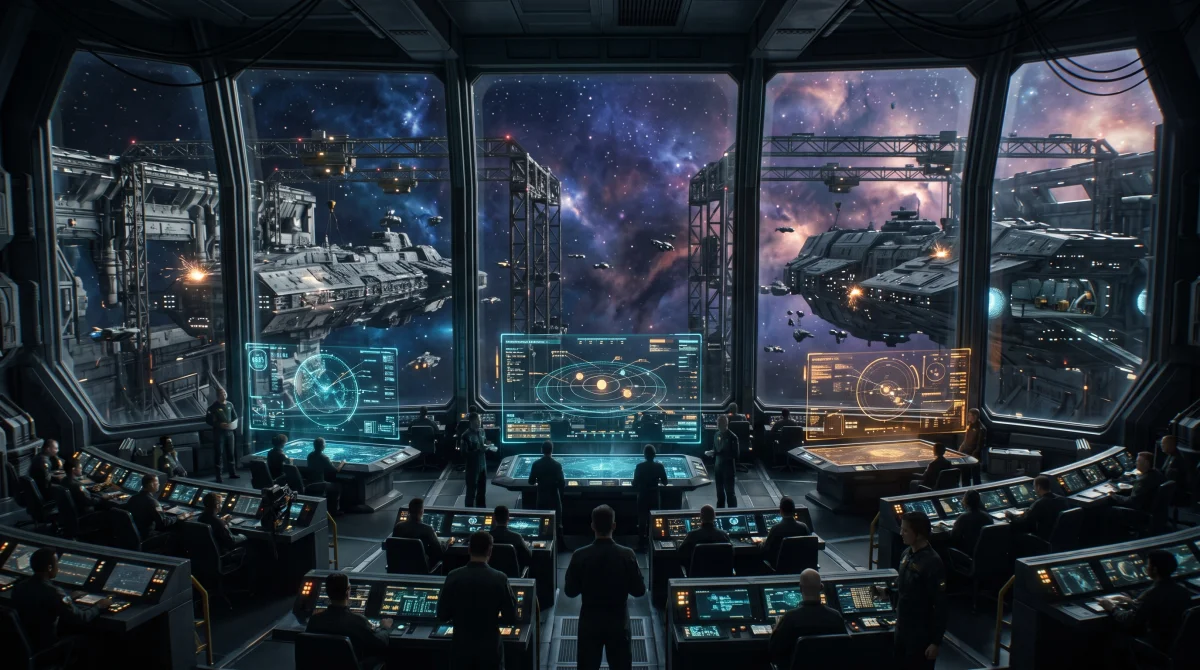
Welcome to the Vanguard Front
Deployment Protocol Initiated: Welcome to the Vanguard Front
ATTENTION, COMMANDER:
Your transponder frequency has been verified and registered on the secure grid. A virgin homeworld in an active solar sector has been assigned to your command. From this moment forward, you assume sole authority over its surface extraction grids, orbital fabrication slips, defensive batteries, and interstellar armadas.
Space is unforgiving, and the surrounding sectors are contested by rival empires and autonomous fleets. Below is your initial operational briefing detailing the core systems at your disposal.
1. Planetary Infrastructure & Sub-Second Reactive Economy
Your dominion relies on three fundamental planetary resources:
- Metal: Structural alloy used for all heavy hulls, plating, and foundational infrastructure.
- Crystal: High-purity optical and resonant silicates powering electronics, shielding, and research vectors.
- Deuterium: Heavy hydrogen fuel synthesized from planetary hydrospheres, critical for fusion reactors, research breakthroughs, and fleet warp burns.
- Energy Grid: Solar collectors, satellites, and fusion cores sustain your mines. Production scales smoothly with power availability; deficits proportionally reduce extraction yields.
2. Scientific Tech Trees & Orbital Fabrication
Construct a Research Lab on your homeworld to advance empire-wide technologies:
- Propulsion Vectors: Combustion, Impulse, and Hyperspace Drives increase maximum flight velocities and reduce transit durations across systems.
- Combat Doctrines: Weapons, Shielding, and Armor Technologies each grant compounding +10% combat multipliers across every hull and defense battery in your empire.
- Astrophysics: Expands your operational colony reach, allowing you to settle new worlds across the cosmos and launch deep-space expeditions.
- Heavy Shipyards & Nanite Slips: Rapidly fabricate armadas ranging from swift logistical cargo hulls to dreadnought-class battle line warships.
3. Fleet Directives & Planetary Defense Grid
Your fleet command deck supports 8 distinct mission directives:
- Attack: Engage enemy armadas and planetary installations to plunder up to 50% of unprotected resource vaults.
- Transport: Ferry vital supplies between your own colonies or allied bases.
- Deploy: Permanently transfer fleet assets and freight to another planetary base under your control.
- Espionage: Deploy sensor probes to penetrate enemy sectors, returning critical telemetry on defenses, fleet sizes, and resource caches.
- Colonize: Establish permanent new bases using specialized Colony Ships.
- Harvest / Recycle: Dispatch recyclers to recover raw metal and crystal from orbital debris fields left behind by space battles.
- Expedition: Venture beyond charted space into Sector Slot 16 to recover lost tech, aether, or encounter unknown anomalies.
- Federation Defense (ACS): Station ships on allied planets to form unified defensive walls against incoming incursions.
4. Galaxy Scanner, Alliances & Comms
- Galaxy Scanner (
/game/galaxy): Navigate across 9 Galaxies and 499 Solar Systems via 3-tier coordinates (e.g.,[1:105:8]). Dispatch spy probes, raids, or harvest runs with a single click. - Alliances & Federations (
/game/alliance): Form or enlist in interstellar coalitions with custom rank hierarchies, shared defensive pacts, and custom alliance recruitment portals. - Diplomacy & Comms (
/game/messages&/game/friends): Exchange tactical communiqués, dispatch mutual friendship treaties, and track friendly fleet activity.
Accessing the Commander's Tactical Field Manual
When formulating long-term strategies, calculating fleet fuel requirements, or reviewing tech prerequisites, consult the comprehensive flight manual directly from your command terminal:
Inside the manual, you will find:
- Complete tech tree prerequisites and unlock sequences.
- Exact mathematical resource extraction formulas per mine level and thermal slot.
- Full ship and defense specification sheets (integrity, shields, speed, cargo, and rapidfire tables).
- Combat engine algorithms and debris field dissipation rates.